Only tech giants can afford artificial intelligence solutions — this myth has been debunked. And statistics clearly show this. 78% of companies already use AI in at least one business operation, points out McKinsey in their 2025 Global AI Survey.
The question: Does artificial intelligence bring value? — isn't topical. Organizations are concerned with how to create an AI model that solves business problems and delivers results.
The good news? Building an AI model is more achievable than many companies used to think. You don't need to wait for years or look for a team of scientists. You should find a reliable and skilled AI software development team that can build algorithms for your business.
Plus, you need to make a choice: to build a custom AI model for a particular workflow or tailor an existing algorithm to your needs. In both scenarios, you should consider your data, funding, and timeline.
How to make an AI model, what tools can help, and what challenges await you on this path — all these we’ll cover in our guide.
What Is an AI Model?
An AI model is an engine that applies one or more algorithms to data to notice patterns and trends and make decisions and predictions without human assistance. An AI model doesn’t follow set rules for every situation. Instead, it learns from past examples and uses that knowledge when it produces new content, classifies data, or ranks statistics.
We can compare an AI model with a student who learns from practical cases rather than learning dry theory.
Before focusing on how to create an AI model, let’s distinguish between artificial intelligence, machine learning, and deep learning. The reason: this helps you understand what stands behind every AI model.
Artificial intelligence (AI) is the ability of information systems to complete tasks that usually require human cognition. Machine learning uses algorithms and data, enabling data processing systems not programmed for this to learn and make predictions. Deep learning is a more advanced type of ML that uses neural networks to solve complex tasks— such as understanding language or recognizing images.
Different types of AI models solve different problems. Predictive and classification models help businesses make predictions and sort data into groups. Computer vision models recognize visuals and videos. Natural language processing (NLP) models work with text and speech, while generative AI models produce new content — text, images, or code.

How AI Models Work
Every AI model works in a simple sequence: learning from data, using the company’s databases to complete tasks, and upgrading over time. So the model is getting more accurate and useful with each new round of training and feedback. Let’s review all stages of AI models’ work!
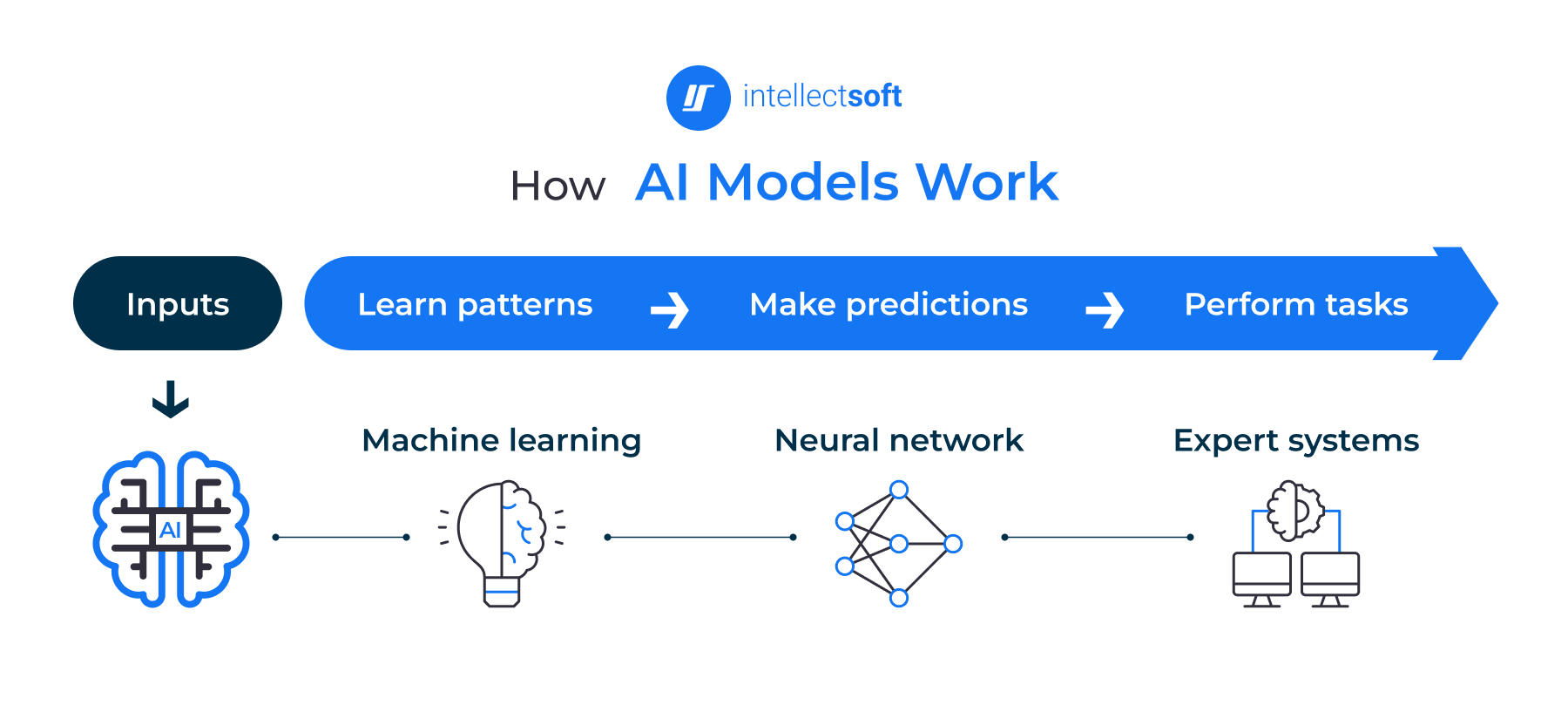
First, it collects and prepares data to be trained on. Next comes training, when ML algorithms learn from the data and find patterns. The model is ready to work with new data — make forecasts, give recommendations, or answer questions. In the end, people review and assess the received outputs and provide feedback. So this helps you understand whether you should refine the model through extra training.
Many modern AI systems, including LLMs, combine multiple learning paradigms. They may use supervised training that involves historical data and unsupervised learning from large datasets. Finally, you can improve your AI model through reinforcement learning to achieve accurate and reliable responses.

How to Create an AI Model in 8 Steps
Building an AI model is both coding and solving real business problems. One is about choosing a development approach and preparing the right data. The other is about understanding your business needs, which building an AI model can cover. Read exactly how we’re doing this at Intellectsoft together with our clients.
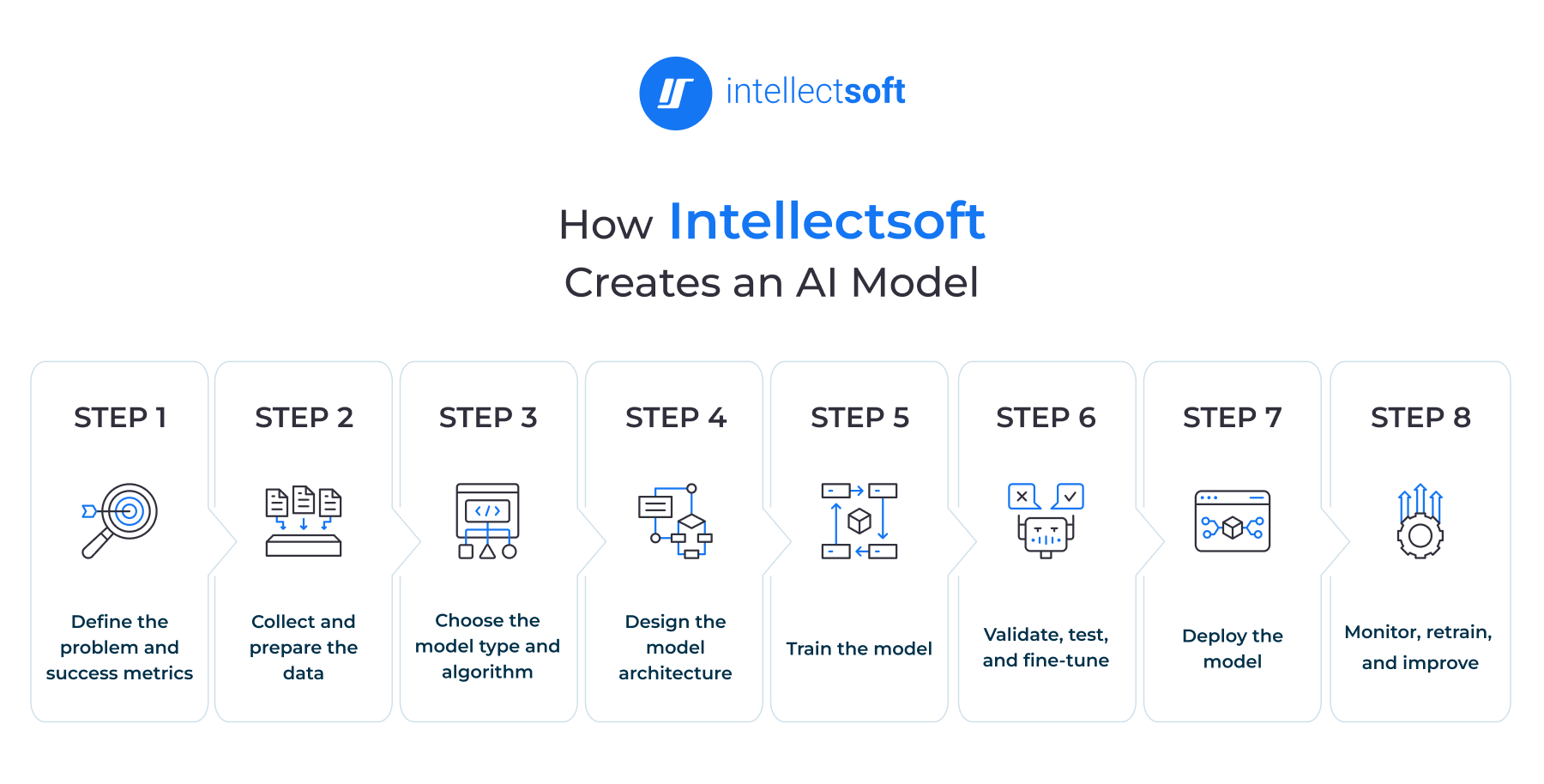
Step 1: Define the problem and success metrics
The first stage in creating an AI model is clarifying what function it should perform in your business. Are you striving to forecast customer churn? Or detecting fraud? Or interested in generating content? Your needs help you pick the type of AI model — classification, regression, ranking, or generation, and you can do this with IT consulting services.
Before you focus on the data, decide how you will measure success — prediction accuracy, response time, cost optimization, or another business KPI.
What decision you need to take: Is the AI model really the best solution, or would analytics solve your problem just as well?
What we deliver: A one-page project brief with the business goal, success metric, and target threshold.
Step 2: Collect and prepare the data
The reality is: you cannot create an AI model without quality data. Certainly, you can rely on your business records, public datasets, third-party data, or even synthetic data. But in this case, you need a lot of time to transform and clean such data, and only after that can you use it for AI model training.
In most AI projects, data preparation takes more time than any other step. For example, a retailer may need two years to collect purchase history and customer demographics before training a recommendation model.
Decision to make: Do you already have enough reliable data, or do you need a separate data collection picked for your project?
What we offer: A clean, transformed, and documented dataset ready for AI model training.
Step 3: Choose the model type and algorithm
Now it’s time to pick the right model. Different problems need different algorithms.
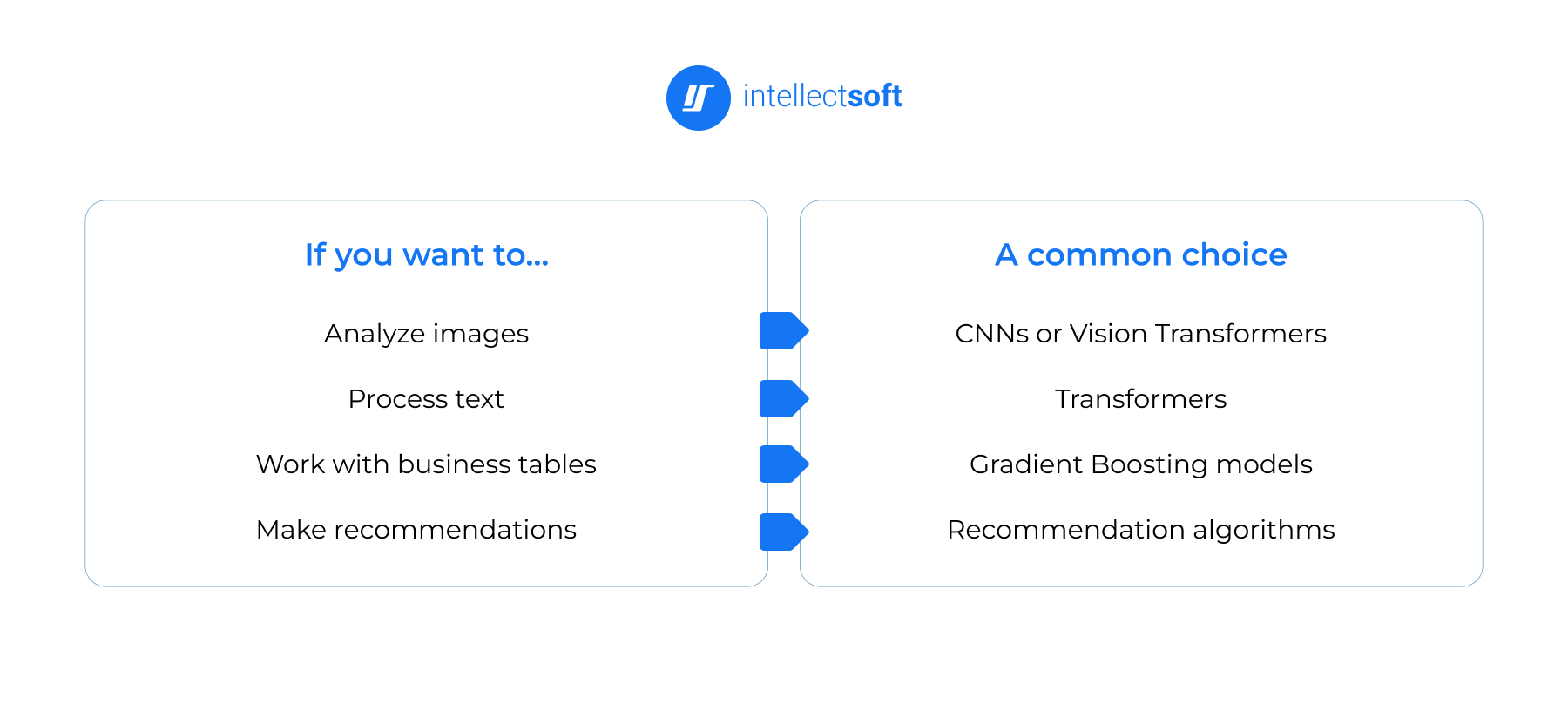
You can begin with creating a simple standard model first. If you can solve your problem with it, there is no need to build something more sophisticated.
What decision you need to take: Build a baseline model before moving to advanced deep learning models.
The results you'll receive: A selected AI model and a clear explanation of why it fits your project.
Step 4: Design the model architecture
If you need a custom AI model, your next stage is to decide how to structure it. You pick the layers, parameters, and other settings to design a reliable architecture. If you want to base it on a pre-trained foundation model, your task is to define how to refine it for your business function.
What you need to decide: Reuse a current pre-trained AI model if possible. It saves time, data, and computing resources.
Here’s what you get: A model architecture ready for training.
Step 5: Train the model
At this stage, your AI model starts learning and extracts patterns from your datasets. During training, the algorithm relies on the company’s data to notice patterns and trends and upgrades with every cycle. As a rule, teams use frameworks like TensorFlow or PyTorch and train models on GPUs or cloud infrastructure.
The role of AI engineers here is to monitor the outputs that the AI model delivers to ensure steady growth of algorithms. They should learn from data and not memorize it.
What you should consider: Save checkpoints and use early stopping so training can be repeated and the best version is not lost.
What you gain: One or more trained AI models with recorded training results.
Step 6: Validate, test, and fine-tune
Training is not enough to get the AI model that you’ll benefit from. It’s a must to check how well the model works on data it has never seen before. So you can measure its accuracy through F1 score, MAE, RMSE, or other metrics, depending on the task it will complete. Of course, you can enhance the algorithm accordingly and test it again until it becomes what you need.
The final testing should be conducted after you complete refining the model.
What matters here: Choose metrics that matter most for your business. For example, finding every fraud case is a metric in fraud detection.
What you can expect: An evaluation report that shows whether the model reached the set success targets.
Step 7: Deploy the model
Your AI model is ready to be released. The algorithm can run through an API, process data in batches, or work directly on edge devices. AI teams deploy it step by step, relying on canary deployments or A/B testing — all to minimize risk and prevent flaws.
In this case, MLOps is very helpful — it automates launches and makes future upgrades much easier.
What to take into account: Decide whether your app needs the fastest response time or the highest processing capacity. And you can do this with AI integration services that will guide you and help make the right choices.
What you receive: A production AI model running with monitoring in place.
Step 8: Monitor, retrain, and improve
Launching the model is not the end of the project, as the situation is very dynamic. Everything changes — data, customer behavior, and business conditions. So it's not strange that AI models lose accuracy over time.
The recent study found that 91% of machine learning models degrade in production. That’s why it’s vital to monitor and retrain algorithms on time to ensure they remain effective for your workflows at scale.
If you notice the algorithm’s accuracy drops, track its performance, watch for data evolution, and re-educate it.
What choice you need to make: Re-optimize the AI model when performance decreases or follow a fixed refining schedule.
What you get: A monitoring dashboard and an automated retraining pipeline.
Building an AI Model from Scratch vs. Fine-Tuning a Foundation Model
You can create AI models using the following methods:
- Build it from scratch
- Fine-tune an existing foundation model
- Use a pre-built API
- Rely on a no-code platform
Of course, the right choice depends on your business needs, data, timeline, and costs.
Why do businesses select AI model fine-tuning? It’s faster, cheaper, and involves less data than training an algorithm from scratch. Companies use this approach to customize LLMs and generative AI apps for their own products and workflows.
Why do businesses choose to train from scratch? It gives them a real competitive advantage. But, indeed, they should rely on a unique dataset.
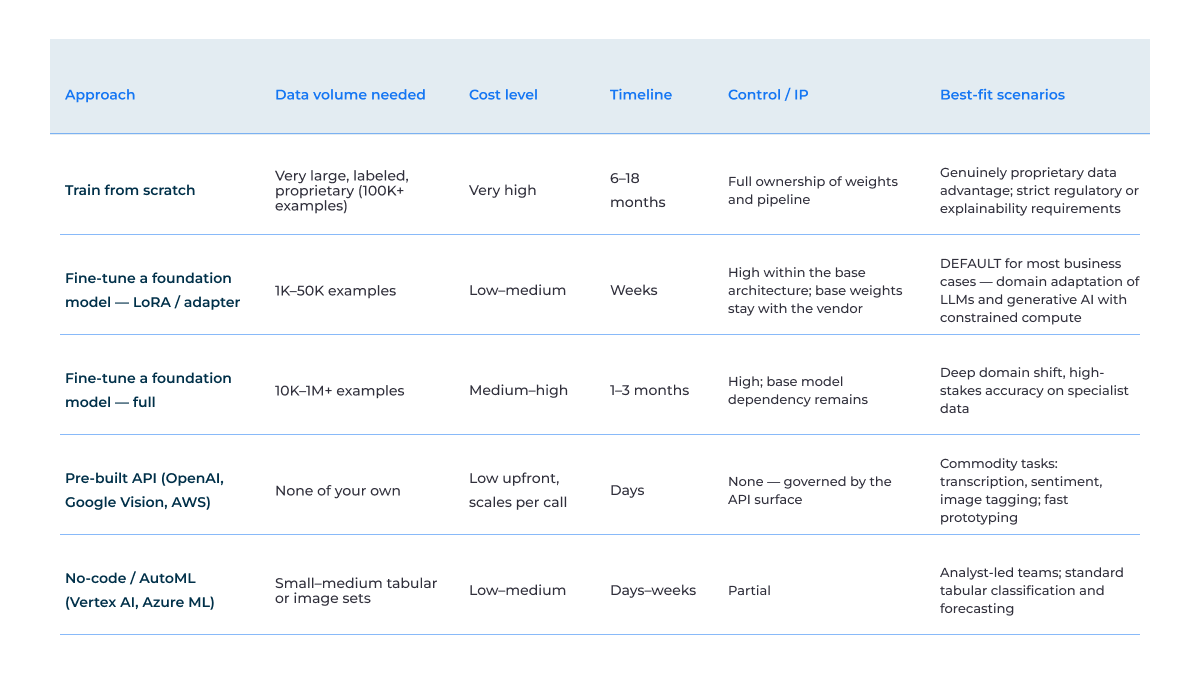
Fine-tuning offers the balance between cost, speed, and performance. You get an AI model tailored to your business. Plus, you save time and money needed for building everything from the ground up.
Training from scratch is a great option when existing foundation models fail to meet your technical, business, or regulatory requirements.
Tools and Frameworks for AI Model Development
You can speed up AI model development with the relevant instruments. So here's the one question you should answer: “Which tools and frameworks should I select?” To answer it, you should rely on your team's skills, the type of algorithm you may need, and how you plan to launch it.
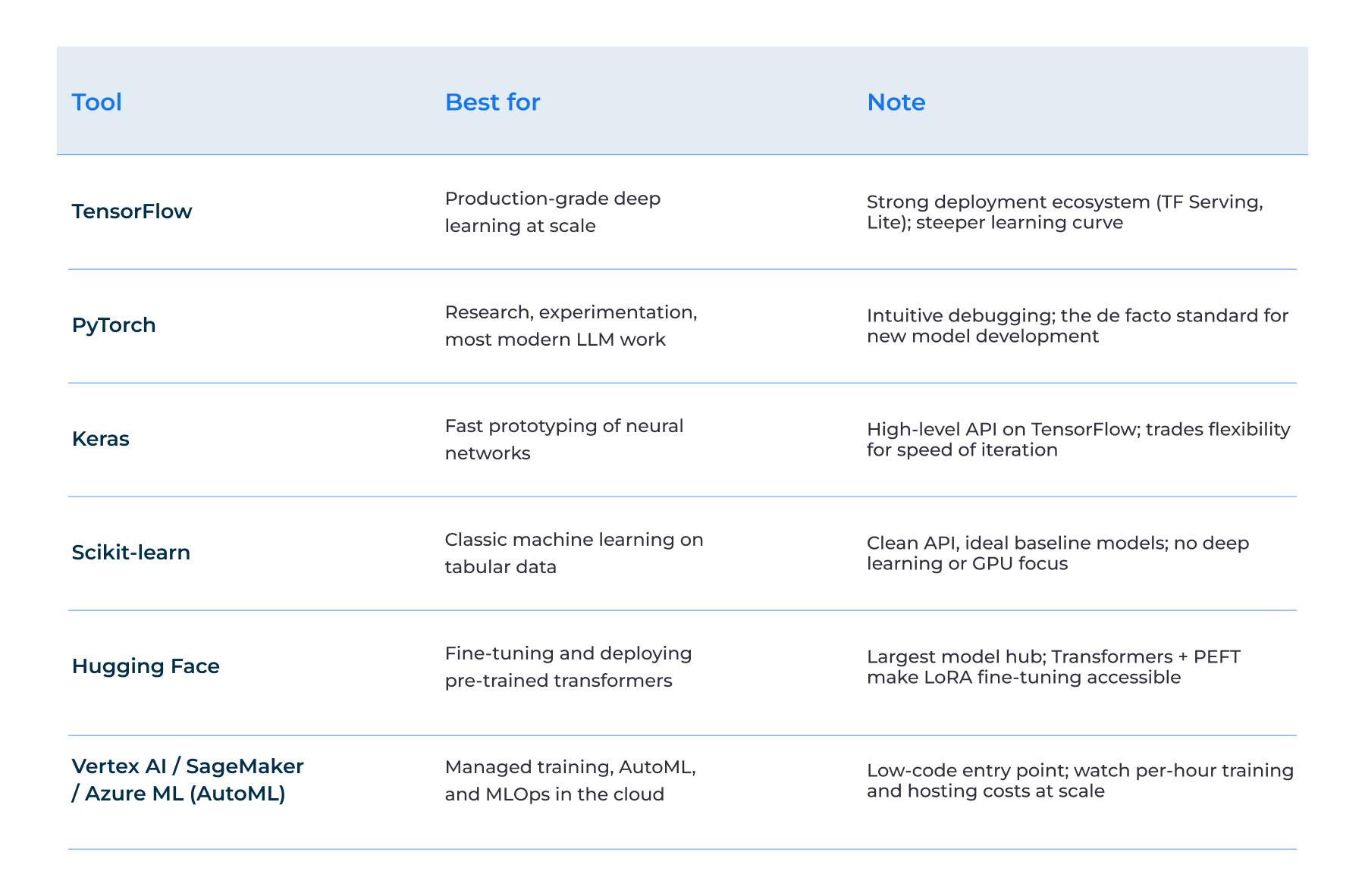
The best tool depends on your team and your project.
- If you're a startup or MVP team, we recommend Keras or Scikit-learn to speed up development, or use pre-built AI APIs for common features.
- The research team should opt for PyTorch with Hugging Face, as they help them stay flexible and access the latest AI models for AI agent development.
- Enterprise teams should pick TensorFlow or PyTorch together with a cloud MLOps platform like Vertex AI, Amazon SageMaker, or Azure ML – all of them guarantee reliable production release.
- If you’re a non-technical or analyst-led team, your ideal choices are AutoML platforms such as Vertex AI or Azure ML.
Challenges of Creating an AI Model
Yes, building an AI model is about picking the right algorithm and training it. But beyond that, you also need a lot of things — reliable data, relevant expertise, and a plan for deployment and sustained support. On your way to this, you should be ready for the following challenges, and of course, start your way from digital transformation consulting.
Data quality and quantity
An AI algorithm's quality is the same as the datasets it learns from. With messy, chaotic, or obsolete data, the algorithm produces poor results. Indeed, you need more time to prepare data than to train the model itself, especially in complex projects.
How to solve it: Audit, clean, transform, and validate your data — all these help you prepare your data for feeding your algorithm and getting reliable outputs.
Talent and development costs
To create AI algorithms for your workflows, you need a qualified, cross-functional team with the right composition— data scientists, ML engineers, software developers, and cloud specialists. So you need to plan the budget to fill skill gaps in advance. Plus, you should factor in costs for testing, deployment, and ongoing support of your algorithms.
How to solve it: You can cut expenses by fine-tuning a current baseline model. Or you can use AutoML for simpler use cases and team up with an AI development company.
Integration with existing systems
Even the most sophisticated AI model creates little value if it fails to connect with your existing software and data sources. Many projects are doomed to failure as integrations are not considered.
How to solve it: You have to design the solution with APIs and integration in mind from the beginning.
Bias, privacy, and compliance
The most common hurdles businesses face. First, AI algorithms are trained on historical data, which is biased and incomplete. The result? Low-quality results. Second, in regulated verticals—healthcare or finance—you have to stay compliant with GDPR or HIPAA. If not, you can deal with legal issues.
How to solve it: In both situations, you should work on your data: check it for bias before training and perform privacy and compliance audits at all stages of AI model development.
Model drift after deployment
You’ve released an AI model. And may breathe with relief. But this isn’t the end. Over time, customers want something new, business processes scale, and market conditions become different. And if you do not update your algorithms accordingly, they will decline.
How to solve it: You should monitor model performance and set up automated retraining when data drift occurs.
How Much Does It Cost to Create an AI Model?
The cost of AI model development depends on the following points: what you are building, how much data you already have, and how the model will be used.
A simple AI model built on existing company data is usually cheaper. But a custom solution that requires new data, complex training, and integration with multiple business systems is costly.
The average situation in the market: a proof of concept (PoC) costs from $20,000 to $50,000. And a working AI model ranges from $100,000 to $500,000+. But if you need a complex enterprise AI platform, your funding should be extremely high. Advanced features, strict compliance, and optimization add significantly to your budget.
The biggest factors that affect the cost of AI model development include:
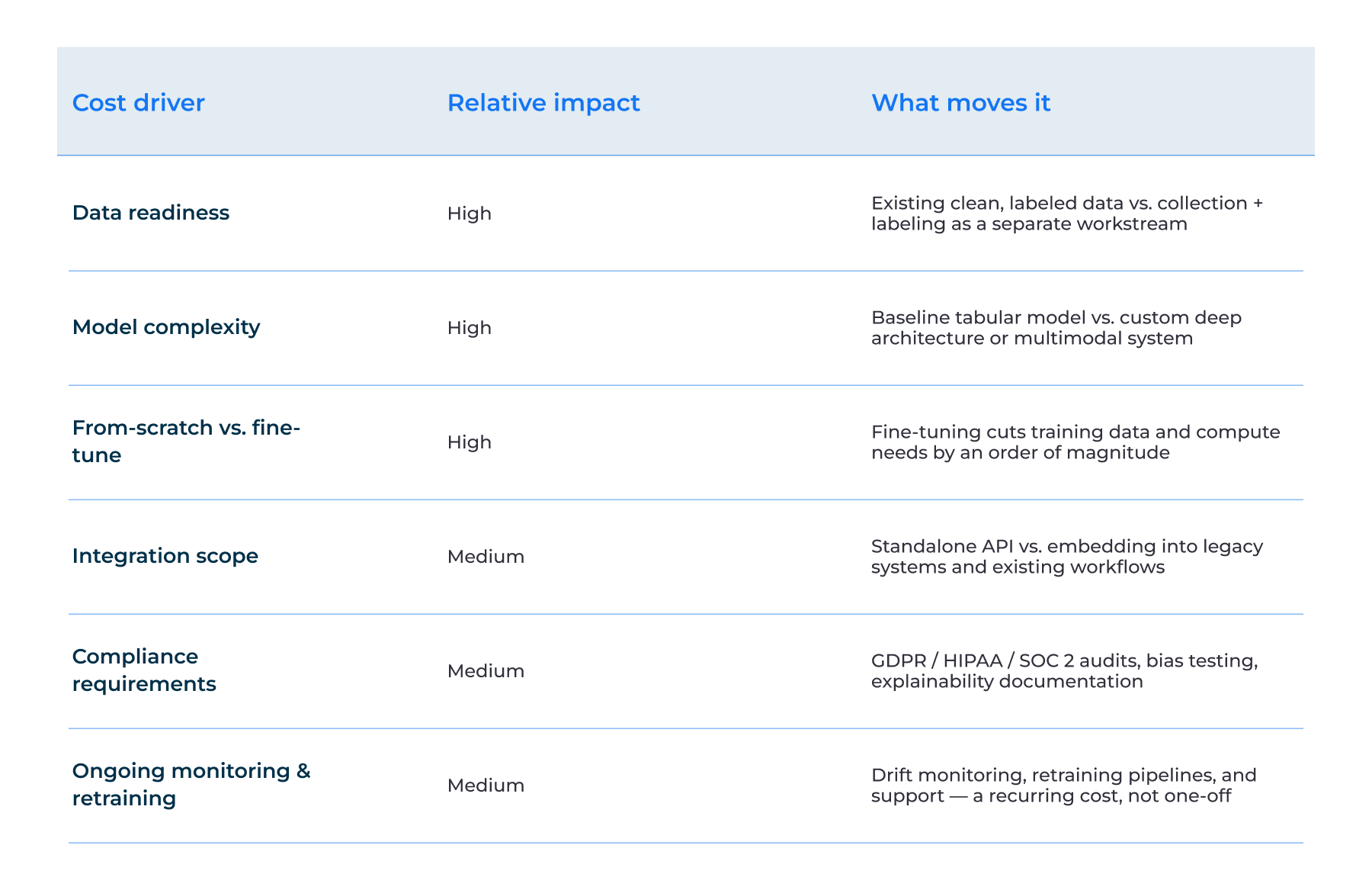
In terms of timing, a proof of concept can often be delivered in 4–8 weeks, while a production-ready AI solution usually takes 3–9 months, depending on the project's complexity.
Disclaimer: The figures in this section are market averages and can be used for planning purposes only. The actual budget of creating an AI model depends on the project scope, data readiness, model complexity, compliance requirements, and integration needs.
Why Intellectsoft for AI Model Development
AI model building is much more than training an advanced algorithm. You need the right business case, accurate data, reliable integration, and sustained support to make sure the model works with benefits for businesses.
With 18+ years of software engineering experience and 35 Fortune 1000 clients, Intellectsoft offers custom AI model development services with proven client case studies. We help you define the right use case to integrate AI where it brings value. Plus, we also prepare your data to ensure your algorithms deliver accurate predictions and responses. Our AI developers build and fine-tune the model and integrate it into your existing software. Finally, we monitor its performance after deployment.
Our team has hands-on experience creating AI models for businesses in fintech, healthcare, construction, and logistics. Whether you are building your first artificial intelligence solutions or scaling AI across your company, with our AI software development, we deliver models that solve real business problems.
FAQ
How do I create my own AI model?
To create a precise, secure, and practical AI model, you should take these steps:
Define the problem you strive to address
Collect and prepare your data
Choose the right algorithm
Design and train the model
Validate the AI model’s accuracy
Deploy algorithms into your application
How to make an AI model without coding?
Yes, it’s possible to create an AI model without coding with no-code platforms — Google Vertex AI AutoML, Azure Machine Learning, and H2O.ai. But keep in mind that this AI model can perform simple tasks: tabular data analysis, image classification, and basic prediction tasks.
But no-code platforms have restrictions. You can’t use them for building a customized model with sophisticated business logic and the ability to integrate with many systems. In this case, you need custom AI model development.
How to build AI models for business?
We recommend defining a business problem that you want to solve. Then, you should train your AI model based on your company’s datasets — reliable and accurate. Next, refine your current algorithm as it requires less time and money. Otherwise, you need to build an AI model around your business needs from scratch. In the end, you should have a strategic plan for embedding the model into your current software and workflows. All is done without disrupting them and with tracking how it works after deployment.
How long does it take to create an AI model?
A proof of concept — 4-12 weeks
A production-ready AI model — 4-9 months
The timeline hinges on your data and the number of systems you need to connect with. Indeed,
preparing and transforming the data requires more time than training the AI model itself.
How much does it cost to create an AI model?
Your data readiness, model complexity, integration requirements, and compliance needs – all these aspects affect how much you pay for developing an AI model. Fine-tuning an existing model is cheaper than building a model from scratch. But the largest investment you have to make is custom AI model development.
What is the difference between building an AI model from scratch and fine-tuning?
For building an AI model from scratch, you need to train it on your own data from the start. And the advantage here is that you get the most control over it. But indeed, it’s expensive and time-consuming.
For AI model fine-tuning, you need to teach your existing model to perform a specific task. It is faster and costs less. This is the best choice for most business projects, while building from scratch is better for covering unique needs.
What data is needed to create an AI model?
The training data depends on the type of AI model you're building.
Supervised learning — customer emails tagged by topic, medical images marked with diagnoses, or product photos labeled by category
Fine-tuning an existing AI model — a few hundred to a few thousand high-quality examples
Building an algorithm from scratch — hundreds of thousands or even millions of training data samples.
N.B. It’s more important to have clean and accurate training data than a large dataset.
